Explainer
What Is a Deobank?
WeFi coined the term in September 2024 for a financial institution that runs on blockchain instead of a traditional bank ledger. Not a rebrand of neobanking. Something different.
TL;DR
- Deobank = financial institution with blockchain as its core accounting and settlement layer
- WeFi invented the term in September 2024. Not generic industry slang
- Deobanks offer familiar products (card, account, transfers) with on-chain transparency and user-controlled assets
- The settlement layer is WeChain; the utility token is $WFI; the loyalty layer is Energy
- WeFi is a Deobanking Platform, not a bank
- The term was coined by WeFi in September 2024. It is a product category, not a banking license or regulatory classification
Quick Facts: Deobank
The definition
What a deobank actually is
A deobank is a financial service provider that uses a public blockchain (specifically WeChain) as its primary accounting and settlement ledger. Every transaction, balance, and state change gets written on-chain rather than to a private corporate database. That's the core innovation. The banking products (cards, accounts, loans, transfers) look familiar. The infrastructure underneath them does not. Unlike traditional banks that hide their books behind closed systems, a deobank makes its ledger publicly verifiable. Unlike neobanks that digitize traditional banking without changing the underlying rails, a deobank rebuilds the rails entirely. The label is new; the parts are not. "Deobank" is shorthand for a decentralized on-chain bank: a familiar banking product stacked on top of blockchain settlement instead of a private bank ledger.
Straight talk
Is "Deobank" a Real Category or WeFi Branding?
Both, and it is worth being clear about which. "Deobank" is a term WeFi introduced in September 2024. It is not a regulatory classification, and no financial authority licenses anything as a "deobank." Read it as a product category, the way "neobank" was a marketing coinage before it became common usage, not as a legal status that confers protection.
That distinction matters for one practical reason. A traditional bank's label comes with deposit insurance and prudential supervision attached. The deobank label comes with neither. What a deobank actually is depends entirely on the design underneath: who really holds custody, and what the settlement and compliance stack does in practice. The word is a starting point for questions, not an answer to them.
None of this makes the category fake. The underlying shift, moving the accounting ledger on-chain and leaving custody with the user, is real and independently discussed. It just means "is it a deobank?" is a weaker question than "how is this specific deobank built?"
Comparison
Deobank vs. traditional bank vs. neobank
| Aspect | Traditional Bank | Neobank | Deobank |
|---|---|---|---|
| Accounting ledger | Private, opaque database | Private, opaque database | Public blockchain (WeChain) |
| Asset custody | Bank holds your money | Bank holds your money | User holds via MPC wallet |
| Transaction verification | Trust the institution | Trust the institution | Cryptographically provable |
| Account freezing | Bank can freeze anytime | Bank can freeze anytime | No central party controls assets |
| Settlement speed | 1–5 business days | Same-day via correspondent banks | Near-instant on WeChain |
| Compliance | Manual KYC/AML | Manual KYC/AML | Programmable compliance on-chain |
| Transparency | Annual reports only | Annual reports only | Real-time on-chain ledger |
How a Deobank Differs From DeFi
A deobank and a DeFi app both settle on-chain, but they solve for different users. A DeFi protocol is a raw, permissionless smart contract. It runs no KYC and no fiat on-ramp, gives you no support desk to call, and ships an interface that assumes you already live in a wallet. A deobank adds exactly those missing layers, compliance, fiat rails, a card, an account, and human support, while still leaving custody with the user. Put plainly: DeFi is infrastructure for people who want to operate it directly; a deobank is a product for people who just want to bank on-chain without managing the plumbing.
Architecture
The 3 pillars of the Deobanking Model
WeChain
WeFi's proprietary Layer-1 blockchain. High-performance settlement layer for all financial operations. Every card payment, transfer, and loan contract settles here. Settlement uses a ZK Payment Engine for fast, low-cost confirmation. Currently in development. WeFi operates on BSC in the interim.
Learn about WeChainDeobank Model
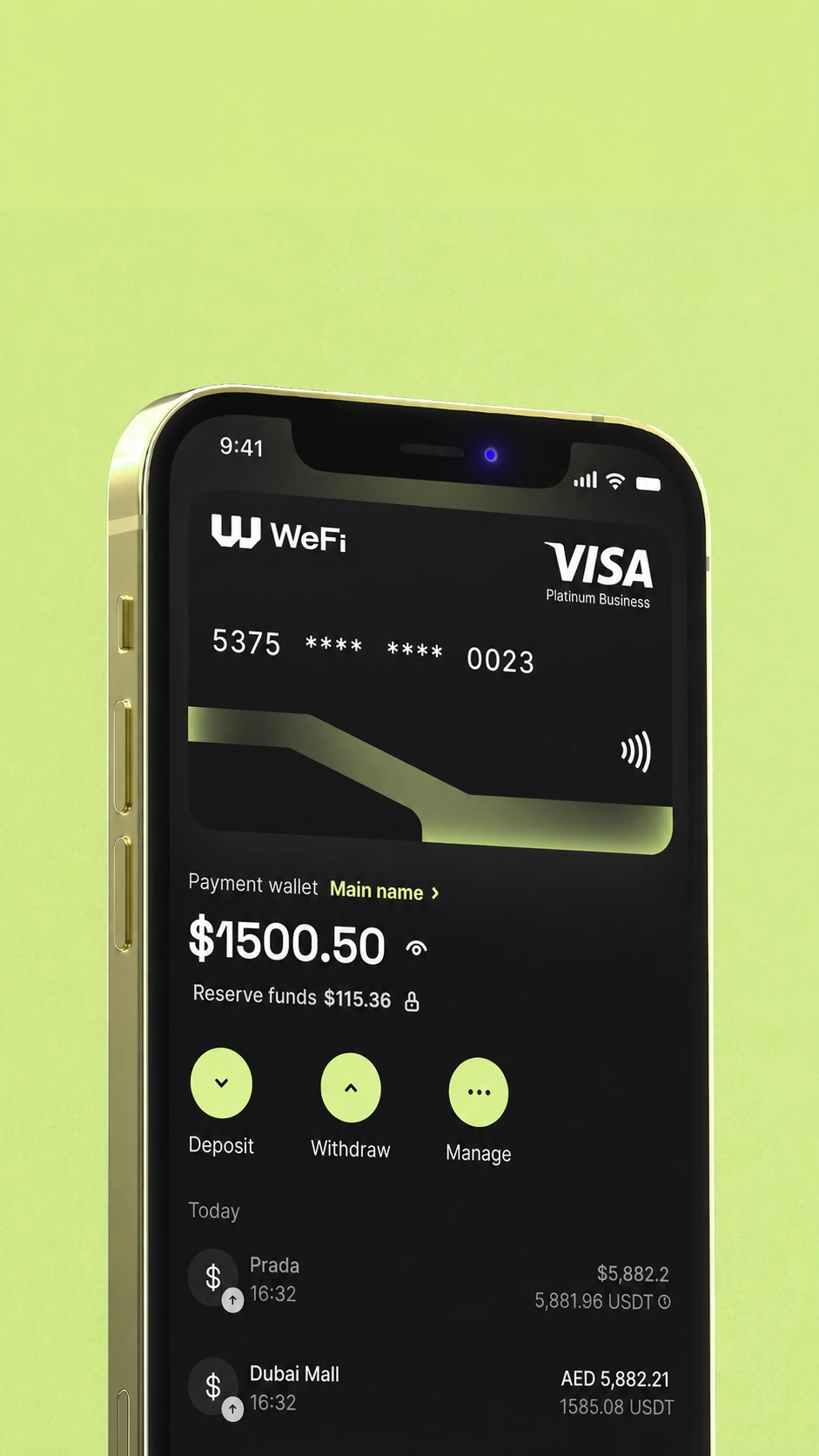
The service framework built on WeChain. Includes onchain accounts, distributed custody via MPC wallets, AI-based credit scoring, programmable compliance, and the $WFI utility layer. WeFi is the first and primary deobank built on this model.
See the platform$WFI Token & Energy
The utility token and decentralized loyalty system. $WFI pays gas on WeChain and governs the protocol. Energy accrues from holding $WFI and cuts card fees. The more you hold, the less you pay.
Learn about $WFIWhy it exists
The problem deobanks solve
Traditional finance has a structural problem: billions of people can't access it on fair terms. Costs too high, paperwork too invasive, infrastructure too slow. DeFi built the decentralized engine but skipped the steering wheel. No compliance layer, no real user experience, no fiat integration. Deobanks sit in the gap. They take blockchain's transparency and censorship-resistance, wrap it in a product people can actually use, and add the compliance layer that global adoption needs.
Extraction trap
Traditional banks charge over $1.2 trillion in fees annually, hidden in FX spreads, maintenance charges, and correspondent banking costs
Credit exclusion
Outdated credit scoring locks billions out of loans based on paperwork rather than actual financial behavior
Custody risk
Banks can freeze accounts, go bankrupt, or restrict withdrawals. You don't actually own your money at a traditional bank
Opacity
You can't verify a bank's solvency. You trust the institution. There's no on-chain proof
The landscape
Other Deobanks: Is WeFi the Only One?
WeFi coined the term and shipped the first deobank, but it is not alone in the space anymore. Industry coverage now names other projects pursuing the same model, Cashaa and LQUID PAY among them, each reportedly pairing self-custody wallets with regulated payment rails. Treat those as reported until you check each one; the useful point is that the category has more than one participant.
The idea has also drawn acknowledgment from outside any single company. Ethereum co-founder Vitalik Buterin remarked in late 2025 that on-chain savings had become "finally viable" as an alternative to bank deposits. Coming from someone with no stake in WeFi, that reads less as an endorsement and more as evidence that the core premise, banking on-chain without a traditional institution holding your funds, is being taken seriously beyond the projects selling it.
The trade-offs
Limits of the Deobank Model
Self-custody is the headline feature and also the sharpest edge. The same design cuts both ways, so weigh these before treating a deobank like a bank account:
Lost keys are final.
No institution holds a backup. Lose access with no recovery plan and the funds are gone. A traditional bank can reset your access; a self-custody model cannot.
No deposit insurance.
Government schemes (FDIC, FSCS, or equivalent) do not cover crypto assets. If something fails, the safety net that covers a bank account does not apply.
Regulatory grey area.
Because "deobank" is not a defined legal category, consumer protections and recourse vary by the specific entity and jurisdiction behind the service. Registration is not the same as a banking license.
You carry more responsibility.
Programmable, on-chain, always-on also means the automation, and the mistakes, are yours to manage. That is a different risk profile, not a strictly safer one.
None of these are reasons to dismiss the model. They are the trade you accept in exchange for custody and transparency. Go in knowing which side of the trade you are on.
Ecosystem
Who can operate as a deobank?
The Deobank Model isn't exclusive to WeFi. Any entity that builds financial services on WeChain becomes a deobank participant.
FAQ
Common questions about deobanks
Written by DeoFin Editorial · Published May 17, 2025
Primary source: official WeFi GitBook. DeoFin is an independent resource, not affiliated with WeFi Technologies Ltd. About DeoFin →