WeFi Ecosystem
WeFi Energy System Explained
Energy is WeFi's internal loyalty metric. Hold $WFI and it accrues. Spend it to cut your WeFi Card fee from 3% to 1.5%, or put it toward mining output. Independent explainer.
Start Farming Energy →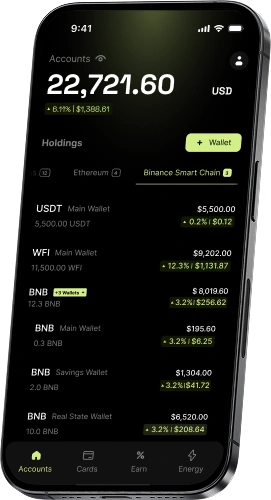
Key Takeaways
- Energy is not a cryptocurrency. Non-transferable, non-tradeable loyalty metric inside the WeFi ecosystem.
- Main use: cuts the WeFi Card fee from 3% to 1.5%. Half the fee on every transaction.
- Two ways to accrue: Daily Farming (gradual, stays liquid) and Advanced Farming (full Energy upfront for a 1 to 5 year lock).
- Price rises +$0.10 per $1M burned globally. Not traded on exchanges. No crypto volatility.
- Energy can't be sold or transferred. It gets consumed by WeFi products.
Quick Facts: Energy
What is Energy
What is WeFi Energy?
Energy is WeFi's internal synthetic gas: a loyalty metric that exists only inside the platform. You can't buy it on any exchange or transfer it between wallets. When you use WeFi services, Energy gets consumed.
Energy has a price, and it gets spent when you use the platform. The more you hold, the more you can do. The price doesn't move with crypto markets. WeFi sets it programmatically based on how much Energy gets burned across the ecosystem. Higher global burn raises the baseline. No exchange listing, no speculative swings. Energy is also not the WFI or WEFI ticker you see on exchanges; those are tradeable tokens. Energy never gets a ticker, never lists, and can't leave your account.
How Energy works
Three roles of Energy in WeFi
Operational Fuel
Energy gets burned to cover platform fees. On the WeFi Card, enough Energy drops your transaction fee from 3% to 1.5%. It also covers fees on internal swaps and asset transfers.
Mining Power Boost
Energy's second job is converting held value into working mining capacity. It's what lets you activate fresh ITO Mining Units instead of only running the ones you started with.
Value Stabilizer
Your service costs stop tracking the crypto market. They track platform activity instead, because fees are priced in Energy rather than in $WFI or fiat. A WeChain mechanic called the Monetary Stabilization Coefficient (MSC) handles that, following how much Energy the whole ecosystem burns.
How to get Energy
Energy farming
Energy accrues two ways: Daily Farming and Advanced Farming. Both require $WFI in your WeFi account. Energy is a utility metric, not an investment instrument. Short version on which to pick: Daily keeps your $WFI liquid and rewards you for leaving it alone; Advanced locks it for 1 to 5 years but issues far more Energy upfront. The 'Best for' row on each card sums it up.
Daily Farming
Hold $WFI in your Onchain Banking Account and Energy accrues daily. The Time Factor (loyalty multiplier) grows the longer you leave your $WFI alone. Send any $WFI out, though, and the Time Factor resets to zero. You rebuild from day one, so a single outbound transfer can erase months of accrued multiplier. Add new $WFI and it inherits your existing Time Factor.
Advanced Farming
Commit $WFI for a fixed period (1 to 5 years) and the maximum Time Factor kicks in immediately. All Energy for that period gets issued upfront. A 5-year advanced commitment produces noticeably more Energy than 5 years of Daily Farming. The commitment period can be extended anytime. The tradeoff: your $WFI stays locked for the full term. Advanced Farming exchanges liquidity for more Energy upfront, so it fits $WFI you don't expect to move during that window.
Energy Referral Programs
Basic Referral Energy
The Basic Referral Energy program rewards participants based on their network activity across multiple levels. Eligibility and rates depend on ITO Mining Unit holdings. Full details available in the KOL's Platform.
If someone is not eligible, rewards compress upward to the next qualified upline.
Unlimited Referral Energy
Rewards distributed across the full referral tree, to unlimited depth.
- Requires KOL Rank 1
- Reward percentages are determined by KOL Rank and distributed across the referral tree. Details available in the official KOL platform
- Fair distribution through the Equal Rule
- Comes from all Energy-generating activities
Any unused referral allocation is burned, increasing Energy value.
Energy applications
What Energy does in the WeFi ecosystem
Card fee reduction
Hold enough Energy and your WeFi Card fee drops from 3% to 1.5%. On a $1,000 transaction, you're paying $15 instead of $30. Scale that to real spending: $2,000 a month runs $720 a year in fees at 3%, or $360 at 1.5%, a $360 annual difference. The more you spend, the more the reduced rate matters.
Mining power boost
Use Energy to add ITO Mining Units at full power. New units rebalance your pool and sustain $WFI distribution rates over time.
Premium feature access
Larger Energy balances unlock higher WeFi subscription tiers, including premium card variants and additional features.
Ecosystem price growth
Every $1M of Energy burned globally raises the baseline Energy price by $0.10. Algorithmic mechanic built into WeChain.
Ecosystem connections
Energy in the WeFi ecosystem
Energy runs through every WeFi product. You farm it by holding $WFI in your Onchain Banking Account. The WeFi Card burns it on each transaction. ITO Mining uses it to activate new units at full power. WeChain governs pricing through the Monetary Stabilization Coefficient (MSC). And every fee you pay in Energy adds to the global burn total, which is what nudges the baseline price upward over time.
WeFi Card
Each card transaction burns Energy and applies the 1.5% fee rate. Without Energy, the standard 3% applies.
$WFI Token
Holding $WFI in your Onchain Banking Account triggers Daily Farming. Commit $WFI for 1 to 5 years and you get Advanced Farming with the maximum Time Factor applied from day one.
ITO Mining
Energy activates additional ITO Mining Units at full power. New units rebalance your pool against older, amortized ones to sustain higher $WFI distribution over time.
WeChain
WeChain enforces Energy pricing through the Monetary Stabilization Coefficient (MSC), calculating Product Coefficients for each WeFi service so Energy price tracks burn activity rather than market prices.
Price model
How Energy is priced
The pricing is a formula, not a market. Every $1,000,000 burned across the ecosystem lifts the baseline by $0.10. On top of that, each WeFi product carries a Product Coefficient set by its share of total burn, so the same Energy can cost slightly more or less depending on where you spend it. The busier the platform, the higher the baseline climbs. It runs as a protocol mechanic on WeChain. DeoFin is an independent resource, not financial advice.
Start farming Energy today
Hold $WFI and Energy accrues from day one. Open your account and start farming now.
Create WeFi accountFAQ
Common questions about WeFi Energy
Written by DeoFin Editorial · Published May 18, 2026
Primary source: official WeFi GitBook. DeoFin is an independent resource, not affiliated with WeFi Technologies Ltd. About DeoFin ->