AI Orchestration Layer
The intelligent management system that monitors WeChain for security, optimizes liquidity, and powers behavioral credit analysis within the WeFi ecosystem.
29 terms from WeFi's official GitBook. Plain definitions, sourced directly.
WeFi introduced deobanking in September 2024 as a category of financial services built on blockchain settlement rails instead of traditional bank ledgers. The concepts behind it - Cloud-Based Mining, Energy, Pool Coefficient, Behavioral Capital, WeChain - do not map neatly to conventional finance. Each term below is sourced from official WeFi documentation and rewritten for clarity. Related terms are linked so you can follow the entity graph without leaving the page.
The intelligent management system that monitors WeChain for security, optimizes liquidity, and powers behavioral credit analysis within the WeFi ecosystem.
Sub-module of the Decentralized Credit System (DCS) that analyzes onchain behavior — interaction quality and repayment promptness — to calculate creditworthiness without a traditional credit score.
One of WeFi's four algorithmic rules. Gradually reduces the mining efficiency of older CBM Units over time, preventing whale dominance and ensuring newer participants remain competitive.
The AI-driven 'Intelligent Shield' within WeFi that identifies irregular transactional patterns to protect Deobanks and End-Users from fraud in real time.
WeFi software layer enabling cash-in and cash-out functionality through partner ATM networks, as well as CBM Unit activation directly at ATM terminals.
A personal onchain asset in WeFi representing a validated history of positive ecosystem behavior, used to unlock premium financial products including credit and advanced subscription tiers.
A digital mining node providing second-by-second access to $WFI token emission over a multi-year mining cycle. Activated via the ITO (Initial Technology Offering).
WeFi's resource-efficient algorithmic $WFI distribution model. Inspired by Bitcoin's fairness and scarcity principles but requires no physical hardware — mining is software-based and runs in WeFi's cloud infrastructure.
Regulated entities within the WeFi ecosystem that securely hold fiat, crypto, and real-world assets (RWA) using MPC protocols to back synthetic local currencies.
Decentralized On-Chain Bank. A financial institution operating at the intersection of traditional finance and decentralized finance, using blockchain as its core accounting layer instead of legacy bank ledgers.
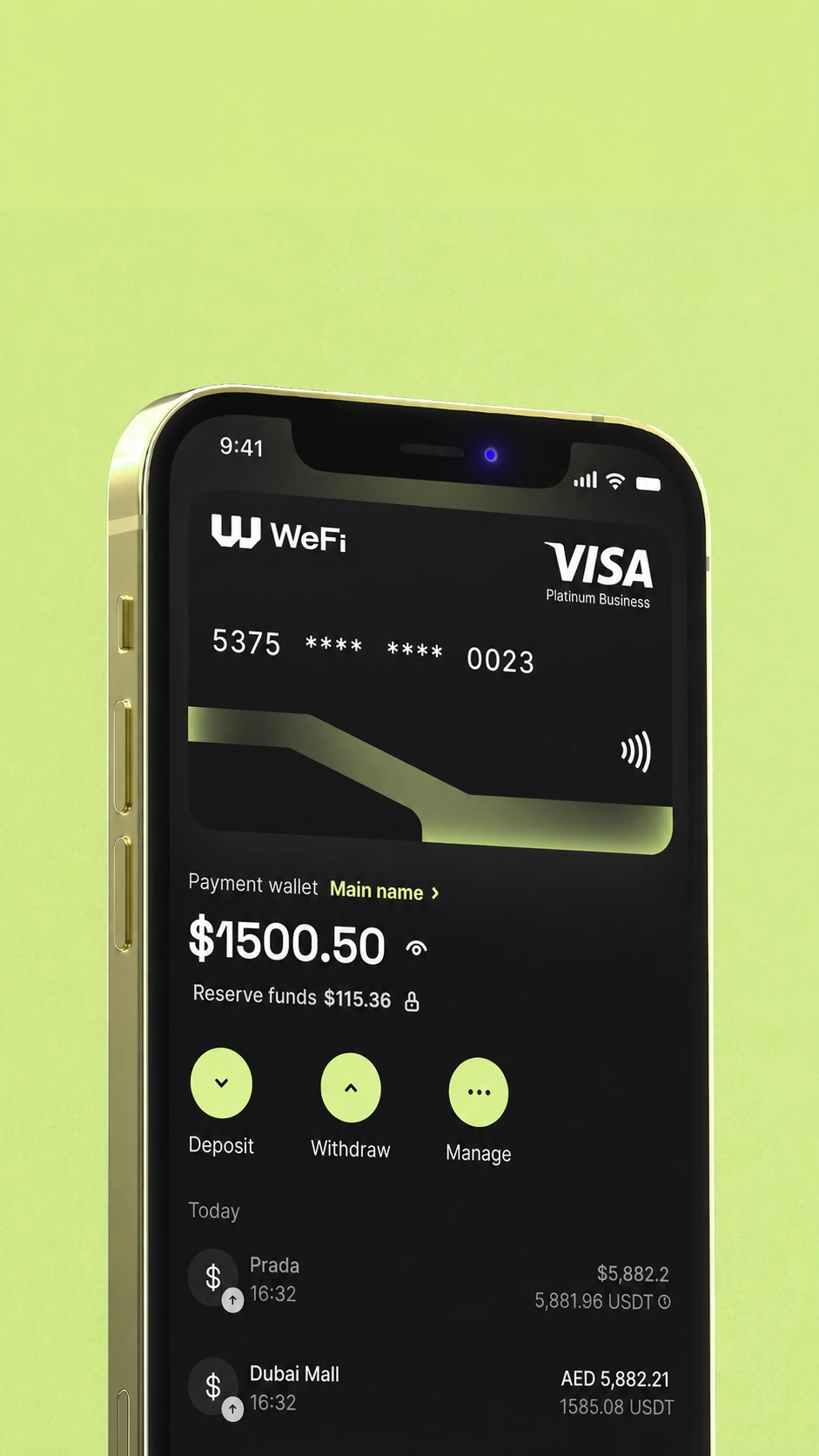
WeFi's default operational wallet. Uses Multi-Party Computation to distribute private key shares across multiple parties so regulated partners can authorize card payments without controlling the underlying assets.
A proxy unit created when $WFI is acquired and committed through farming. Indicates ecosystem engagement, reduces WeFi Card fees from 3% to 1.5%, boosts mining power, and regulates $WFI market release. Cannot be withdrawn or sold.
WeFi's cloud mining activation mechanism. Users activate CBM Units (software-based mining nodes) to participate in $WFI distribution over an ~8-year schedule. Not an ICO or token sale — it funds software infrastructure, not fundraising.
WeFi's dynamic, behavior-based scoring system that replaces traditional credit scores. Determined by consistent engagement with the WeFi ecosystem — not credit history, income documents, or bank statements.
One of WeFi's four algorithmic rules. Regulates how much $WFI enters the market based on proven ecosystem demand, using Energy levels as the maturity signal — not market speculation or human discretion.
A measure of a user's proportional share in WeFi's Cloud-Based Mining pool. Determines what percentage of distributed $WFI a user receives each second. Accumulated through CBM Unit activation and WeFi Card spending.
WeFi software that transforms any NFC-enabled smartphone into a secure, compliant payment terminal for Deobanks and merchants — no dedicated hardware required.
WeFi's cold storage solution for long-term wealth preservation. Private keys are stored on a physical NFC hardware card — funds cannot move without a physical tap to authorize the transaction.
WeChain's immutable, publicly verifiable ledger that records every transaction within the WeFi ecosystem. Provides radical transparency — any participant can verify balances and solvency without trusting a third party.
WeFi's core banking product. A single account that exists simultaneously in fiat and crypto worlds, connecting to traditional payment rails (for card spending) and WeChain (for onchain activity). Comes in Local (domestic) and Global (worldwide) variants.
A mining efficiency multiplier assigned at ITO Unit activation. Larger single activations receive higher coefficients — a $1,000 one-time activation is programmatically more powerful than four $250 activations totaling the same amount.
WeFi-built software connecting third-party point-of-sale terminals to WeChain. Enables merchants to accept crypto payments with zero transaction fees. Hardware is supplied by Deobank operators.
WeFi's financial model where onchain stablecoin reserves back synthetic fiat currencies — the inverse of traditional banking, where fiat deposits back digital balances. Stablecoins are the 'new gold standard.'
WeFi's mechanism that converts every WeFi Card payment into a productive onchain event. Each transaction increases the cardholder's Mining Power — spending is not terminal, it accumulates onchain value.
Global currency units (USD, EUR, AED, THB, etc.) anchored 1:1 to onchain stablecoin reserves in WeFi. Provide instant global liquidity without traditional correspondent banking infrastructure.
WeFi's primary deflationary mechanism. Reduces the $WFI mining rate by 50% every two years across 4 stages. Inspired by Bitcoin halving but applied to algorithmic cloud-based mining.
The 180-day linear release process for mined $WFI tokens. Mined tokens do not become immediately liquid — they vest gradually over 180 days to ensure controlled entry of supply into circulating markets.
The native utility token of the WeFi ecosystem and WeChain blockchain. Fixed supply of 1 billion. Used for card fee reduction (via Energy farming), gas fees on WeChain, governance, credit collateral, and mining rewards.
WeFi's proprietary high-performance blockchain network. Serves as the primary payment, settlement, and accounting rail for the entire deobanking ecosystem. Currently in development — WeFi operates on BSC (BEP-20) in the interim.
Learn more about WeFi
Maintained by DeoFin Editorial · Last updated May 2026
Definitions sourced from the official WeFi GitBook. DeoFin is an independent resource, not affiliated with WeFi Technologies Ltd. The glossary gets updated as WeFi ships new products. About DeoFin ->
External references: Investopedia — Blockchain · CoinGecko Crypto Glossary