Independent Review

WeFi Review 2026

WeFi is the first platform to call itself a deobank. After analyzing its products, team, regulatory footprint, and documentation, this is our informed take — what works well, what's in progress, and who WeFi makes sense for.

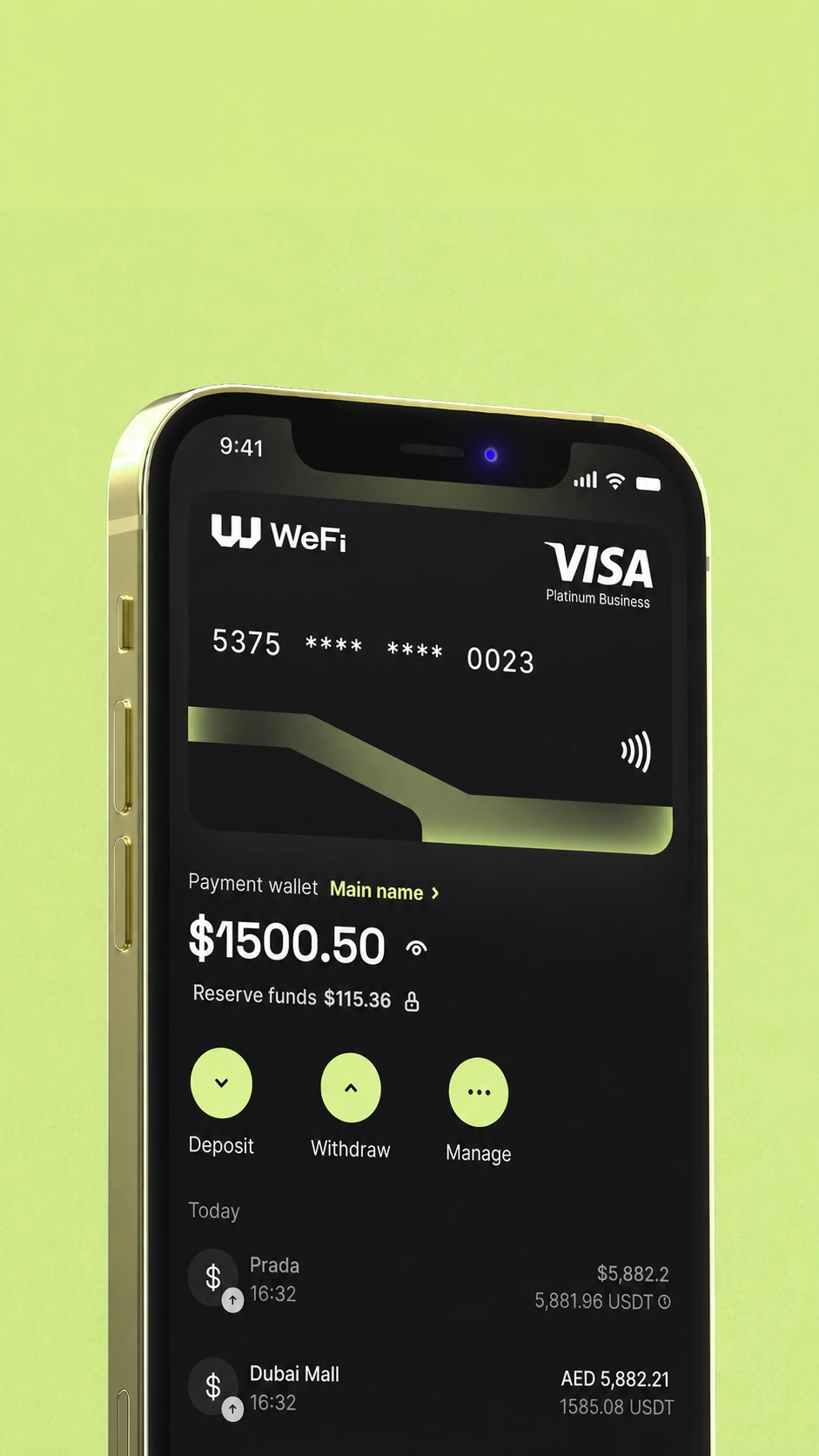
WeFi 2026 review showing platform features, card tiers, and deobanking metrics
This website is an independent informational resource. For official information, please visit: wefi.co

TL;DR

  • Our verdict: credibly founded and operational. Regulated in Canada (FINTRAC), Czech Republic (VASP), Hong Kong, and St. Vincent & Grenadines. Co-founded by a Tether co-founder. MPC self-custody means WeFi cannot unilaterally access your assets.
  • WeFi Card charges 1.5% per transaction with Energy — among the lowest rates in the crypto card space.
  • ITO Mining Units are software infrastructure products that participate in $WFI token distribution. No hardware required. Activation is permanent, so understand the product before committing.
  • WeChain (WeFi's own Layer-1) is in active development. The platform runs on BSC in the interim — a proven, liquid chain. No confirmed mainnet date yet.
  • $WFI accrues over 180 days via linear vesting. Energy is a non-transferable loyalty metric that reduces the card fee from 3% to 1.5%.

Quick Facts: WeFi Platform

Founded2024
Term coinedDeobank — September 2024
LicensesFINTRAC (Canada), VASP (Czech Republic), Hong Kong, SVGFSA
WeFi Card fee1.5% (with Energy)
BlockchainBSC BEP-20 (WeChain in development)
Users200,000+ (WeFi's claim, unverified)
$WFI vesting180 days, linear
ITO Mining Stage 18 WFI/second distribution rate
MPC custodyDistributed — user controls assets
What is WeFi

30-second summary

WeFi is a Deobanking Platform founded in 2024. It coined the term 'deobank' to describe a financial service provider that settles transactions on a public blockchain rather than a private corporate ledger. The product stack is already live and operational: the WeFi Card connects to an on-chain MPC account and works at 140M+ merchants, ITO Mining distributes $WFI according to a transparent 8-year schedule, and the Energy loyalty system reduces card fees automatically as you hold $WFI. A Decentralized Credit System and the proprietary WeChain Layer-1 are in active development and will extend the platform further. DeoFin is an independent KOL resource. This review is not an endorsement or official communication from WeFi.

Product breakdown

WeFi products reviewed

WeFi Card

Payment

A payment card connected to a user's on-chain account. Available in virtual, plastic, and metal variants. Accepted at 140M+ merchants via global payment networks. Transaction fee is 1.5%. The Spending-as-Mining mechanism means each payment contributes to the user's mining power; this is a software mechanic, not a cashback promise.

Our take

The 1.5% fee is one of the more competitive rates in the crypto card space. The card works for everyday purchases at 140M+ merchants, and the Spending-as-Mining mechanic adds a layer no traditional card offers — each payment contributes to your mining power as a software mechanic.

Good to know

New users start at the 3% rate. The 1.5% fee unlocks as Energy builds through $WFI holdings — so the benefit grows over time as you use the platform.
ITO Cloud-Based Mining

Software Infrastructure

ITO (Initial Technology Offering) Mining Units are software infrastructure products that participate in the $WFI token distribution mechanism on WeChain. No physical hardware is required. Activation is a one-time, irreversible action. The algorithmic emission schedule spans 8 years with halvings: Stage 1 distributes 8 WFI/second, Stage 2 distributes 4, Stage 3 distributes 2, Stage 4 distributes 1. This is not an investment product.

Our take

The 8-year emission schedule and halving model are documented and verifiable in WeFi's GitBook. ITO Mining is one of WeFi's most distinctive features — participating in $WFI distribution without hardware or technical setup is a genuinely novel software mechanic. The transparent schedule means you know exactly what the distribution rate is at any given stage.

Good to know

Activation is permanent and the product is software, not an investment. The $WFI you receive depends on market conditions WeFi does not control. Understand the product before activating. This is not financial advice.

$WFI Token

Utility Token

$WFI is the native utility token of the WeChain network, currently live on BSC as a BEP-20 token. Fixed supply: 1,000,000,000 tokens. Uses include: card fee reduction input via Energy, gas on WeChain, governance, and access to ecosystem features. Distribution follows an 8-year algorithmic schedule. $WFI accrued through ITO Mining vests over 180 days linearly.

Our take

$WFI has well-defined utility across the WeFi ecosystem — fee reduction, gas on WeChain, governance, and ecosystem access. The fixed supply of 1 billion tokens and the 8-year algorithmic distribution schedule give $WFI a predictable issuance model. Tokens from ITO Mining vest over 180 days on a linear schedule, which means accrual is steady and predictable.

Good to know

$WFI is a utility token, not an investment instrument. Market value is not guaranteed. This is not financial advice.

Energy is a non-transferable loyalty metric within the WeFi ecosystem. It is not a cryptocurrency or separate token. Energy accrues automatically by holding $WFI in your WeFi account. Its functions: reduces the WeFi Card transaction fee from 3% to 1.5%, contributes to mining power on ITO Units, and unlocks access to higher-tier ecosystem features. Energy pricing follows a programmatic model tied to ecosystem activity.

Our take

The Energy layer is a coherent loyalty mechanic that ties together card fees, mining power, and tier access into a single metric. Cutting the card fee from 3% to 1.5% is the most immediate and tangible benefit — it makes WeFi Card genuinely competitive for everyday spending. The non-transferable design keeps Energy as a usage reward rather than a speculative asset.

Good to know

Energy builds gradually with $WFI holdings. New users see the full 1.5% rate unlock over time as their $WFI balance grows.

Decentralized Credit System

In Development

WeFi's AI-based credit scoring system evaluates behavioral data rather than traditional credit bureau inputs. The goal is to provide loan access to users who are underserved by conventional financial institutions. The system is not fully launched across all jurisdictions.

Our take

The concept addresses a genuine gap: credit access for users outside traditional banking. AI-based behavioral scoring instead of credit bureau checks opens DCS to users conventional lenders cannot serve. The product is in rollout — availability varies by jurisdiction.

Good to know

Check whether DCS is live in your jurisdiction before planning around it. No universal launch date has been confirmed.

WeChain

In Development

WeChain is WeFi's proprietary Layer-1 blockchain built on Cosmos SDK. It is designed as the settlement layer for all WeFi financial operations. Features under development include Zero-Knowledge Proofs for privacy and a decentralized AI compliance engine. WeChain is not yet live. WeFi currently operates on BSC as an interim solution.

Our take

WeChain is built on Cosmos SDK — a proven, battle-tested framework used by dozens of production blockchains. The technical direction is sound. BSC handles settlement reliably in the interim. When WeChain goes live, it completes WeFi's core promise of fully on-chain settlement.

Good to know

WeChain is not yet live. All WeChain-dependent features are planned, not operational. No confirmed mainnet date at time of publication.

Assessment

What works & what to track

What works

  • Regulatory registrations in four jurisdictions: Canada (FINTRAC), Czech Republic (VASP), Hong Kong, and St. Vincent & Grenadines. Not a single-jurisdiction operation.
  • Founded by a Tether co-founder (Chairman) and a Group CEO with fintech infrastructure background. Team includes veterans from Tether, Wise, Binance, and Bybit. Public professional records, not claims.
  • MPC (Multi-Party Computation) wallet architecture. Distributed custody means WeFi cannot unilaterally freeze or seize your assets.
  • WeFi Card fee of 1.5% with Energy is factually lower than most competitors in the crypto card space. The comparison table in this review shows the gap.
  • ITO Mining has a transparent, pre-defined 8-year emission schedule with four stages. The halving mechanism is documented and follows a predictable algorithm.
  • Energy system provides concrete utility: fee reduction and mining power contribution. Non-transferable design reduces speculative layering.

Good to know

  • WeChain is in active development with no confirmed mainnet date. BSC handles settlement in the interim reliably, but on-chain settlement via WeFi's own L1 is still ahead.
  • User count of 200,000+ is WeFi's self-reported figure — standard for a platform at this growth stage.
  • ITO Mining Unit activation is permanent. There is no deactivation option, so understanding the product before activating is important.
  • $WFI from ITO Mining vests over 180 days on a linear schedule. Accrual is predictable but gradual.
  • Decentralized Credit System is rolling out progressively across jurisdictions. Check availability in your region.
  • New users start at the 3% card fee. The 1.5% rate builds over time as Energy accumulates with $WFI holdings.
Team

Who founded WeFi

WeFi was founded by its Chairman — a co-founder of Tether (USDT), the largest stablecoin by market cap, verifiable through Tether's public founding history — and its Group CEO, who has a fintech infrastructure background. The broader team includes industry veterans from Tether, Wise, Binance, and Bybit. These are public professional records, not insider information. The founding team's credentials are among the stronger legitimacy signals for a 2024-stage platform. A team that helped build Tether knows how to navigate financial regulation and token mechanics. That doesn't guarantee future performance. It does mean they've done this before.

Security & legitimacy

Is WeFi safe?

No platform is risk-free. The question is which signals are verifiable and which are claimed. Below we separate what can be independently checked from what WeFi asserts but cannot be third-party verified at this time. DeoFin is an independent resource. We are not security auditors. This analysis is based on publicly available information only.

Regulatory registrationsVerifiable

FINTRAC (Canada), Czech Republic VASP license, Hong Kong registration, SVGFSA. These can be checked against public registry databases. Registration is not a guarantee of solvency or safety, but it indicates WeFi has submitted to regulatory oversight in multiple jurisdictions.

Founding team identityVerifiable

The founding team's backgrounds from Tether, Wise, Binance, and Bybit are verifiable through public professional records. The Chairman is a publicly documented Tether co-founder. This is a positive signal compared to anonymous founding teams.

MPC custody architectureVerifiable

WeFi's use of Multi-Party Computation wallet architecture is documented in their GitBook. MPC distributes key control so no single party (including WeFi) can unilaterally access user assets. This is a recognized security model used by institutional custodians.

GitBook documentationVerifiable

WeFi's technical and product documentation is publicly accessible. The detail level is above average for a 2024-launched platform. Transparency in documentation is a positive signal, though documentation alone does not guarantee code quality or security.

User count (200,000+)Claimed

This figure is WeFi's own self-reported claim. It has not been independently audited or verified by any third party. We include it because WeFi states it publicly, but readers should treat it as unconfirmed.

WeChain mainnetIn development

WeChain is the planned core settlement layer. It is not live. No confirmed launch date exists. The platform currently operates on BSC as an interim measure. All WeChain-dependent features (on-chain settlement, ZK proofs, decentralized compliance) are not yet operational.

Comparison

WeFi vs alternatives

PlatformTypeCard feeSelf-custodyMiningLicenses
WeFiDeobanking Platform1.5% (with Energy)Yes (MPC)Yes (ITO software)FINTRAC, VASP, SVGFSA
Crypto.comCrypto exchange3.11%**NoNoMultiple jurisdictions
NexoCeFi lender0%*NoNoEU regulated
RevolutNeobankVaries by planNoNoUK FCA, EU

* Nexo 0% card requires significant collateral. ** Crypto.com standard rate applies before CRO staking discounts. Fees shown are standard published rates at time of writing and may change. This is not a recommendation to use any listed platform.

Our verdict

Who WeFi is for, and who it isn't

WeFi delivers on its core promise today: a self-custody crypto card with competitive fees, a software mining mechanic unlike anything in traditional finance, and regulatory credentials backed by a founding team with real fintech history. The card works, ITO Mining distributes $WFI on its published schedule, and Energy reduces fees automatically. The main item to track is WeChain — when WeFi's own L1 goes live, the deobanking vision becomes fully on-chain. BSC handles the interim reliably. For anyone looking for a crypto-native account with a real card, self-custody, and a mining software layer, WeFi is among the most credible options at this stage. ITO Mining Units are software products, not investments. $WFI is a utility token. Nothing in this review constitutes financial advice.

WeFi is for

Crypto-native users who want a self-custody card with competitive fees and a mining software mechanic. People exploring DCS loan access outside the traditional banking system. Anyone who values MPC self-custody over centralized card accounts. Users across the 153 jurisdictions WeFi serves who want a platform built toward blockchain-native settlement.

WeFi is not for

Anyone expecting guaranteed financial returns from ITO Mining — it is a software product, not an investment. Users who need WeChain's on-chain settlement today. People who prefer platforms with five-plus years of operational history. This is not financial advice.

Ready to Get Started with WeFi?

DeoFin is an independent resource. For official platform access and account registration, visit wefi.co.

Create WeFi Account
FAQ

Common questions about WeFi

Based on verifiable signals, no. WeFi holds regulatory registrations in Canada (FINTRAC), Czech Republic (VASP), Hong Kong, and St. Vincent & Grenadines. The founding team has publicly verifiable backgrounds from Tether, Wise, and Bitpanda. GitBook documentation is detailed and public. MPC custody architecture is a recognized institutional-grade security model. These are meaningful legitimacy signals. That said, WeFi is a 2024-stage platform with significant features still in development: WeChain is not live, the Decentralized Credit System is not fully launched, and the 200,000+ user figure is unaudited. Legitimacy is not the same as guaranteed performance. This is an independent analysis, not an endorsement.
WeFi holds regulatory registrations in four jurisdictions: FINTRAC in Canada, a VASP (Virtual Asset Service Provider) license in the Czech Republic, a registration in Hong Kong, and a license from SVGFSA (St. Vincent & Grenadines Financial Services Authority). These registrations are verifiable against public databases. Registration indicates regulatory oversight but does not guarantee solvency, security outcomes, or product success. Coverage varies by jurisdiction. Check whether WeFi operates in your specific country before engaging.
WeFi was founded by its Chairman — a publicly documented co-founder of Tether (USDT), verifiable through Tether's public founding history — and its Group CEO, who has a fintech infrastructure background. The broader team includes industry veterans from Tether, Wise, Binance, and Bybit. All of this is in the public record.
Any financial platform carries risk, and WeFi is no different. $WFI is a utility token with market-determined value. ITO Mining Units are software products — the $WFI you receive depends on market conditions, not a fixed return. WeChain is in development, which is a technology risk to track. These are the same risk categories you'd evaluate with any early-stage crypto platform. The regulatory registrations, MPC self-custody architecture, and credible founding team reduce several of the more common platform risks. DeoFin is an independent informational resource. This is not financial advice. Consult a qualified financial professional before making decisions.
There is no confirmed WeChain mainnet launch date at the time of publication. WeFi has stated WeChain is in development and will serve as the primary settlement layer when live. The platform currently operates on BSC (BEP-20) as an interim solution. We will update this review when a confirmed date is announced. Do not make financial plans that depend on a specific WeChain launch timeline.

Written by DeoFin Editorial · Published May 18, 2026

Primary source: official WeFi GitBook. DeoFin is an independent resource, not affiliated with WeFi Technologies Ltd. About DeoFin →