Deobanking Platform
Decentralized On-Chain Banking — The New Standard
Full control of your money through blockchain accounts, instant crypto spending, global transfers, and smart-contract settlement. Powered by WeFi.
Key Takeaways
- WeFi is a Deobanking Platform — not a bank — giving users full self-custody via MPC wallets
- 200,000+ registered users across 153 jurisdictions as of early 2025
- WeFi Crypto Card accepted at 140M+ merchants — 1.5% fee with Energy, 3% without
- 7,000+ digital assets in one onchain account, no traditional bank account needed
- Licensed through FINTRAC (Canada), VASP (Czech Republic), Hong Kong, and St. Vincent
WeFi Deobanking Platform — Quick Facts
Based on public data. See wefi.co for official details.
What Is Deobanking?
A bank built on blockchain — where you keep the keys
A decentralized on-chain bank runs on public blockchain rails instead of a private ledger, offering familiar banking services while you keep control of your money. This page focuses on the mechanics: how the accounting, custody, and settlement actually work. For the category and definition, see our What Is a Deobank explainer.
How it works
Deobanking Platforms run entirely on blockchain rails, which cuts fees and removes the restrictions of traditional banking. You hold your own assets (self-custody), so no institution can freeze your account, go bankrupt with your funds, or restrict what you do with your money.
- Smart contracts process payments instantly — no human approval
- Every transaction recorded on a public, immutable ledger
- Interest handled automatically on-chain, no counterparty risk
Settlement runs on WeChain — WeFi's purpose-built blockchain on Cosmos SDK.
What WeFi Deobanking Platform includes
- Full control over your assets — no third party can freeze or seize funds
- Traditional banking features: savings, debit cards, yield access
- On-chain payments and transfers via blockchain rails
- Stablecoins for reliable digital money transactions
- Tokenized governance — users participate in platform decisions
Under the hood
How On-Chain Accounting Works
A traditional bank records your balance in a private ledger only it can see. You trust the institution's word that the number is real and that the money behind it exists. An on-chain bank writes every transaction, balance, and state change to a public blockchain instead. WeFi calls this the Onchain Accounting Book.
The practical effect is that solvency becomes checkable. Anyone, including a regulator, can confirm in real time that the assets exist, because the record is a shared public ledger and not a quarterly report they have to trust. Once an entry is written it cannot be quietly changed or backdated, and it cannot be deleted.
Traditional ledger vs on-chain ledger
| Traditional Bank | WeFi Deobanking Platform | |
|---|---|---|
| Ledger | Private, closed database | Public, shared blockchain |
| Verification | Trust the institution | Cryptographically provable |
| Record keeping | Opaque, reported periodically | Real-time, publicly visible |
| Solvency check | Annual or quarterly disclosure | Verifiable at any moment |
| Tamper resistance | Internal controls | Immutable once written |
This is not a claim that on-chain equals safe. It is a narrower point about the accounting: you can verify it yourself.
Custody
Where Your Money Actually Lives
In a normal bank, your deposit is an entry on the bank's balance sheet, and the bank holds the actual funds. WeFi uses a different arrangement built on self-custody, so control stays with you rather than with the institution.
Self-custody through MPC
Assets sit in wallets secured by Multi-Party Computation, where the key is split so that no single party, WeFi included, can move funds alone. WeFi works with institutional infrastructure (Fireblocks) for this layer.
A dual-wallet design
The model separates ownership from day-to-day access, so the wallet you spend from is distinct from the store of ownership. Funds sit in wallets tied to your address, not pooled in a shared omnibus account.
No unilateral movement
WeFi cannot move your assets without your authorization. There is no back-office button that debits your account.
No rehypothecation
Your assets are not lent out or reused behind the scenes. They stay at your address rather than being pooled and put to work, which is the practice that quietly turns bank deposits into loans elsewhere.
Settlement
How Settlement Works
When you pay or transfer, the value moves on-chain rather than through a chain of correspondent banks. Balances are held and settled largely in stablecoins, so a transfer confirms in seconds and does not depend on borders or banking hours. There is no multi-day wait while funds sit in an intermediary.
Fiat still has to enter and leave the system somewhere, and that is where regulated partners come in. On and off ramps run through licensed providers, so converting local currency into an on-chain balance (and back) happens inside a compliant path. Settlement runs on-chain, while the regulated rail is what lets fiat cross in and out.
Trade-offs
Trade-Offs of On-Chain Banking
The mechanics on this page all point one way: control moves to you, and so does the risk that used to sit with the institution. One trade-off is specific to how settlement works here and worth dwelling on.
- On-chain transfers are final.A payment that confirms cannot be reversed by calling support. Send to the wrong address, or approve the wrong transaction, and there is no chargeback and no clawback. In a traditional bank a mistaken transfer can often be recalled; on-chain, finality is the default. That single property changes how carefully you check before you confirm.
The broader trade-offs of self-custody, losing access if you lose your keys and the absence of government deposit insurance, belong to the deobank model as a whole. We cover them in depth in the What Is a Deobank limits section and weigh them against the platform in the WeFi Review 2026. The short version: the verifiable ledger proves the money exists, but nothing reimburses you if you send it to the wrong place.
Old Way vs WeFi
Why the old model is broken
Traditional crypto path
- Find an exchange
- Sell your USDT
- Wait for buyers
- Deal with delays and fees
- Transfer to bank
- Finally spend your money
The WeFi way
- Direct crypto spending worldwide
- No need to move funds
- Instant transactions
- 1.5% transaction fee (with Energy)
- Spend crypto directly
- You've been spending since step 1
WeFi Onchain Account
Fiat and crypto — one account
WeFi onchain accounts unite fiat and crypto into one experience. Manage USD, EUR, AED, and THB alongside BTC, ETH, and 7,000+ other digital assets — full visibility and instant access in one place.
- International payments settled in seconds
- Convert fiat to crypto at real-time rates
- Compatible with Apple Pay and Google Pay
- 7,000+ digital assets in a single account


Cross-border Payments
Send and receive across borders instantly
WeFi connects to global payment rails through licensed partners, enabling real interoperability between banks, cards, and blockchain accounts. Funds don't sit in correspondent banks for days — settlement is near-instant and fully on-chain.
- Send money to cards worldwide, often within minutes
- Bank access across virtually any country
- Transfers routed by currency, region, and speed
- Full on-chain transparency on every transfer
WeFi App
Everything in one financial super-app
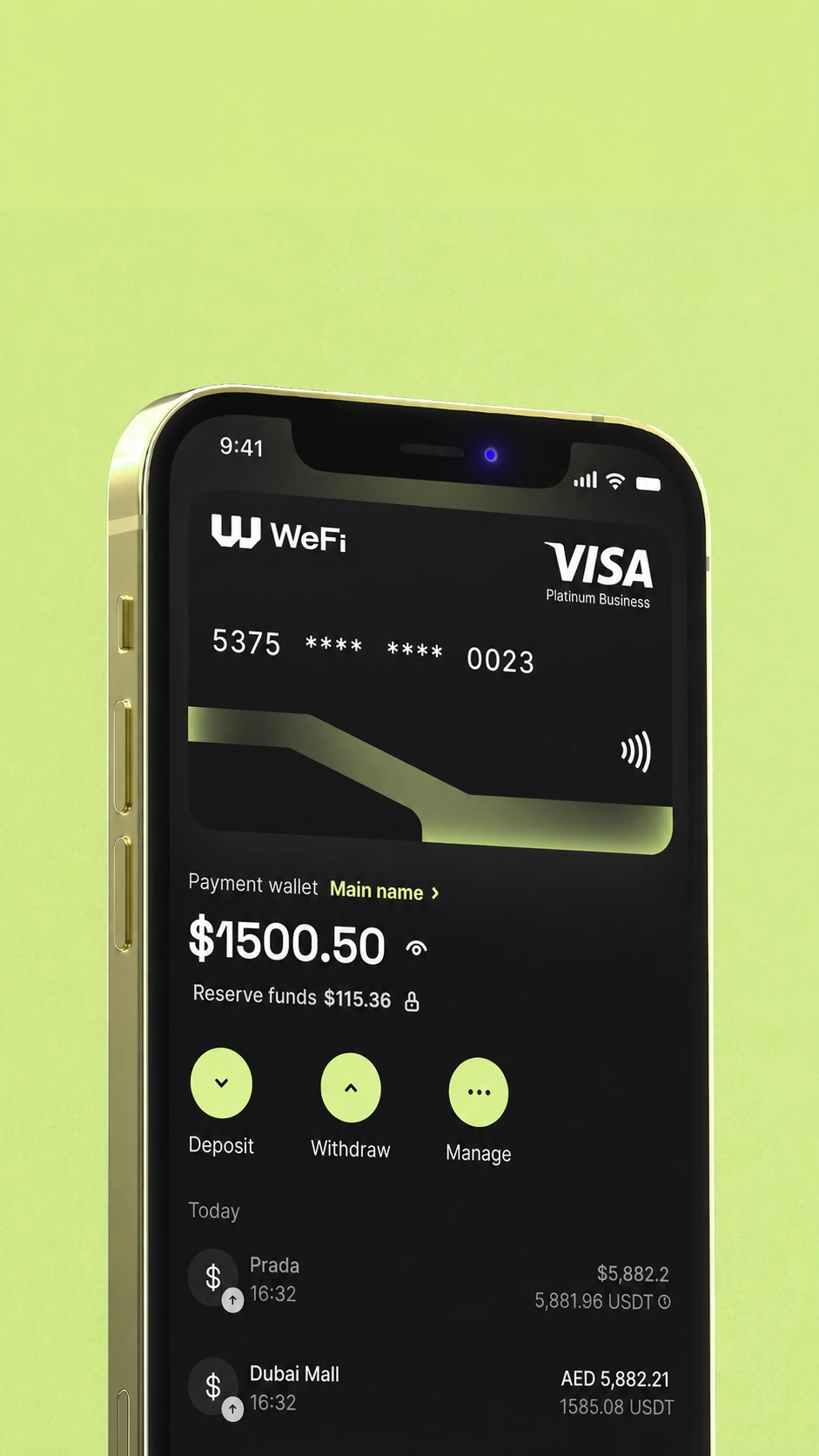
WeFi Crypto Card
- 1.5% fee with Energy
- Accepted at 140M+ merchants
Cross-border transactions
- 0% fee between WeFi accounts
Bank transfers and onramps
- Instant settlements
- Pay with your local method
P2P
- Trade crypto directly with other WeFi users
Loyalty
- Save up to 70% on fees with Energy tiers
Security
- MPC custody — you hold the keys
- Fireblocks institutional infrastructure
Coming Soon
What's next on WeFi
International and local bank transfers
Seamless global and domestic transfers with better speed, flexibility, and transparency.
Fiat and crypto onchain bank accounts
Multiple fiat currencies and crypto assets in a unified, fully onchain account.
Instant fiat to crypto exchange
Convert between currencies in real time with fast settlement and competitive rates.
Onchain fiat and crypto loans
Borrowing backed by secure smart contracts — with or without collateral.
Why WeFi
Why users choose WeFi
Self-custody
You control your assets and private keys. No bank, no freeze, no custodian between you and your money.
WeFi Crypto Card
Virtual and physical cards accepted at 140M+ merchants. 1.5% fee with Energy, 3% without. Zero FX fees on supported currencies.
Cloud-based mining
ITO Mining Units are software infrastructure products that participate in the algorithmic $WFI distribution — no hardware needed.
Low-cost global finance
Low fees, instant transfers, and access across 153 jurisdictions — no legacy banking required.
7,000+ assets in one app
Manage, spend, and track your portfolio across 7,000+ digital assets — all in one place.
On-chain transparency
Every transaction recorded on a public, immutable ledger. No opaque processes, no hidden fees.
On-chain vs Traditional
How on-chain accounting changes finance
| Aspect | Traditional Bank | WeFi Deobanking Platform |
|---|---|---|
| Transparency | Closed system — you see only your balance | Open — every transaction recorded and visible |
| Control | Bank controls records and balances | Immutable ledger — no single party can alter history |
| Trust model | Based on institutional reputation | Trustless — authenticity guaranteed by blockchain code |
| Record keeping | Opaque internal processes, delayed reporting | Publicly verifiable in real time |
| Security | Centralized database, vulnerable to manipulation | Distributed ledger, cryptographically secured |
| Confidence | Blind trust and 'too big to fail' logic | Mathematical certainty and on-chain proof |
FAQ
Questions about Deobanking

Bank on your own terms with WeFi Deobanking
Self-custody banking, a global crypto card, and onchain payments. Open your account in minutes and hold your own keys.
Get Started on WeFi